






Arduino changed who could build electronics. It made microcontrollers more approachable, created a vast learning community, and became one of the most recognizable platforms for physical computing.
But accessible does not always mean simple. Building an Arduino project can still involve choosing compatible sensors, studying pin diagrams, connecting wires, installing libraries, configuring components, and debugging embedded code.
That complexity is valuable when the goal is to learn electronics. It can become friction when the goal is to test a product idea, run a classroom activity, or explore a prototype quickly.
Incipe approaches the problem from a different direction. Instead of asking people to learn the hardware stack before they can create, Incipe is designed to understand connected hardware and help generate the code needed to make it work.
What is Incipe?
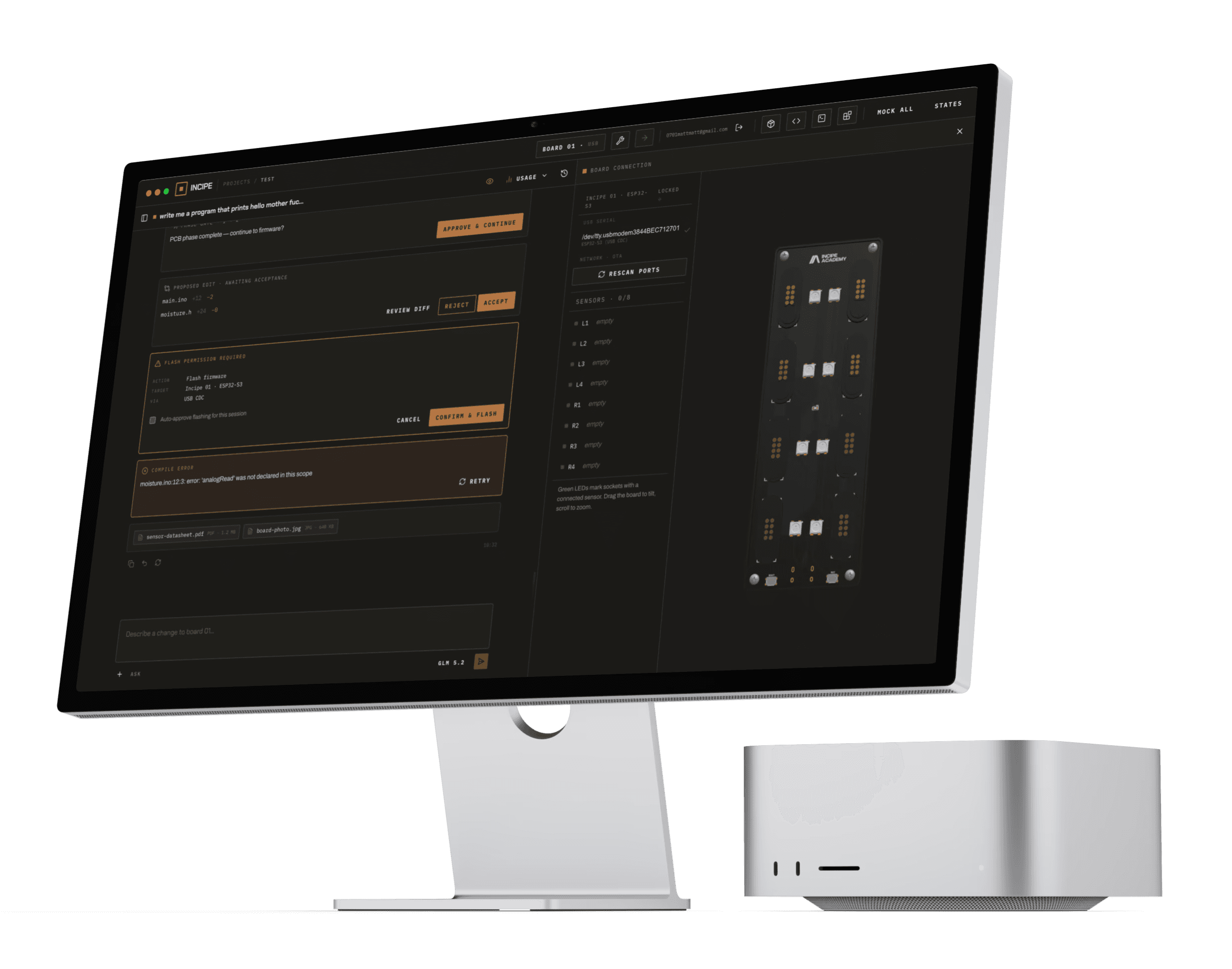
Incipe is an AI-powered hardware creation ecosystem built around three connected elements: an AI-powered microcontroller, SensorSync-compatible sensors and modules, and a hardware-aware AI coding agent.
Users attach a compatible component through Incipe’s magnetic SensorSync interface. The system is designed to identify what is connected, giving the AI the hardware context it needs to help generate appropriate embedded code.
The central idea is simple: describe the device you want to build instead of starting with wiring diagrams and datasheets.
Incipe vs Arduino: what is the difference?
Arduino is a broad, mature, and flexible electronics ecosystem. Incipe is a guided hardware creation platform focused on reducing the number of technical decisions users must make before they can begin prototyping.
Area
Arduino
Incipe
Primary experience
Learn, program, and control electronics
Turn an idea into a working hardware prototype
Connecting components
Headers, breadboards, cables, shields, or plug-and-play modules depending on the kit
Magnetic SensorSync-compatible modules
Hardware recognition
Usually configured through the selected board, libraries, and code
Designed to identify compatible connected hardware automatically
Coding
Arduino sketches through desktop or cloud tools, with an experimental AI Assistant available
Hardware-aware AI coding based on user intent and connected components
Best suited to
Makers and engineers who want control and a deep learning ecosystem
Creators who prioritize simplicity, speed, and guided prototyping
Why Incipe can be a useful Arduino alternative
For projects where the main goal is prototype exploration, Incipe’s value is not that Arduino cannot build the same things. In many cases, it can. The value is that Incipe aims to reduce the setup knowledge required to begin.
Traditional microcontroller work often starts with wiring, pin mapping, library selection, and basic embedded structure. Incipe’s SensorSync approach is intended to make compatible modules easier to attach and easier for the AI agent to understand.
That makes the platform especially relevant to designers, product managers, students, educators, founders, and software developers who understand the device they want to make but do not necessarily want embedded engineering to be the first barrier.
When Arduino may still be the better choice
A credible comparison should also acknowledge where Arduino remains strong. Arduino may be the better choice when a project needs access to a mature global community, a very wide selection of third-party components, detailed control over wiring and firmware, or extensive existing tutorials and examples.
Arduino’s flexibility is one of its greatest strengths. Incipe deliberately exchanges some of that open-ended complexity for a more guided experience. The decision is therefore less about which platform is universally better and more about what you want to optimize.
A practical way to decide
Choose Arduino when the goal is to learn and control the hardware stack. Consider Incipe when the goal is to make the hardware stack get out of the way of the idea.
Who should consider Incipe?
Incipe is especially promising for beginners, educators, designers, product managers, students, founders, and software developers who are new to embedded systems. For these users, the most important question is often not, “Which microcontroller has the largest ecosystem?” It is, “How quickly can I make my idea work?”
Frequently asked questions
Is Incipe easier than Arduino?
Incipe is designed to reduce manual wiring, component configuration, and embedded coding through SensorSync and hardware-aware AI. Arduino offers more flexibility and a much larger existing ecosystem, but that flexibility can require more technical knowledge.
Can Incipe replace Arduino?
It can be an alternative for beginner, education, and rapid-prototyping projects supported by compatible modules. Arduino may remain preferable for advanced projects requiring extensive third-party hardware support or low-level control.
Is Incipe a no-code hardware platform?
It is more accurate to describe Incipe as an AI-assisted hardware platform. Its goal is to reduce the amount of code users must write manually while still producing embedded code underneath the experience.
The bottom line
Arduino helped millions of people learn how to build electronics. Incipe represents a different next step: helping people create hardware without requiring electronics and embedded programming to become their first priority. For creators searching for an Arduino alternative that prioritizes speed, accessibility, and AI-guided prototyping, Incipe is worth watching.